
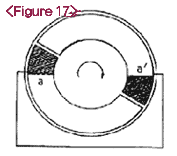
Polar number would mean that of stator and the rate of stator to rotor is 1 to 2. When a stator with one pole like in Figure 5 is combined with a rotor with two poles like in Figure 6, a simple rotor like in Figure 13 is made.
Let`s suppose that when a stator is rotated in the direction of → and for t second with a certain velocity, the changed areas become a[㎠] and a'[㎠](The unit of [㎠] will below be omitted.).
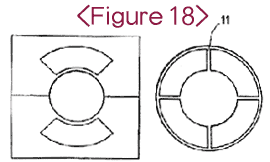
And then when a stator of two poles is combined with a rotor with four poles after they made like Figure 14 with the same sizes as Figure 5 and 6, a simple generator like in Figure 15 is made.
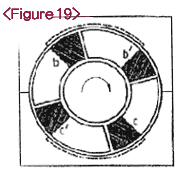
And when a rotor is rotated in the direction of → and for t second at the same velocity with Figure 13, the changed areas become b, b', c and c'. Accordingly,
a=a'=b=b'=c=c'
2(a+a') = (b+b') + (c+c')
Like this, they are the same sizes, but when polar number becomes two, the changed area also becomes double and when polar number becomes three, the changed area also becomes three times ..... and when polar number becomes n, the changed area also becomes n.
That is to say, the changing area of rotor becomes proportioned to polar number.
Thus, because the electricity stored in the whole area of rotor does not flow into external circuit at a time, but whenever a rotor is rotated, the electricity of changing area flows into external circuit, electric current becomes increased with a certain size, proportioned to polar number. In other words, when polar number is heightened two, three, ...... n times, the capacity is increased two, three, ...... n times, or the velocity of rotation becomes two, three, ...... n times fast. Therefore, if the former formula of
W = 2 CV2 Nt [J]
is multiplied by polar number(E), the amount of electric energy flowing to outside while rotor is rotated for t second becomes
W = 2 CV2 NEt [J]
When this is expressed by electric power(P),
| P = | W | [W] |
|
|
| t |
| P = | 2 CV2 NEt | = 2 CV2 NE [W] |
|
|
| t |
This is a basic formula to calculate the output of electrostatic induction generator. And this formula of output is broken down into electric voltage and electric current.
P = 2 CV2NE[W]
Because
P = 2CV2NE [W]
can be broken down into
P = 2 CV2NE [W]
So when
P = Vi [W]
V is electric voltage and
P = Vㆍ2 CVNE [W]
ⅰ = 2 CVNE [A]
is electric current. Like this, it can be found that while sizes are the same, output and electric current are proportioned to polar number. This is already made public as No. 91-13655.
And because frequency (f) is the product of rotation no.(N) multiplied by polar no.(E), it becomes
is electric current. Like this, it can be found that while sizes are the same, output and electric current are proportioned to polar number. This is already made public as No. 91-13655. And because frequency (f) is the product of rotation no.(N) multiplied by polar no.(E), it becomes
f = NE/sec [Hz]
But polar number should not be heightened without limit. Because when
polar number is heightened, the number of insulated line(11) proportioned
to polar number is also increased, and it means that the effective area
is decreased as much.
Thus, polar number should be fixed moderately.
This is just an example in which the electrostatic induction generator is applied to an automobile. It can also be a power source for all transportation means including airplane and ship. In addition, it can replace the methods of existing power generation such as thermal, hydroelectric and atomic power generation, so its commercialization would completely address the matter of energy and environmental pollution.
The electric current of the electrostatic induction generator is not beyond 2CVNE[A], meaning that it is not dangerous. The amount of the electric current never increases more than the initial 2CVNE[A] even in the case of short circuit. The electronic induction generator, however, increases the amount of its electric current sharply on leaking its electricity, which leads to accidents like a fire or electrocution. Therefore, there is no possibility of the electrostatic induction generator causing fires and electrocution without safety devices.
Besides, the electric current of the electrostatic induction generator never heightens the temperature of the generator. I will explain why. The electrode number of both sides of one rotor is 96(the electrode number of one side of a rotor is 48) and the number of rotors is 47. Thus, the whole number of one rotor's electrode is 4512(96×47). The first electric current in experiment 1 is 76[mA], so the amount of the electric current flowing in one electrode of a rotor is 0.0168[mA](76÷4512). Like this, the electric current of the electrostatic generator is relatively weak and it flows divided into all the electrodes of a rotor. Accordingly, it can be said that the amount of the electric current flowing in one electrode of a rotor is nearly null. And, the resistance of the electrode is also close to null since the shape of the electrode is not a slender and long leading wire but a flat plate. This is why the generator is not heated. The negligible heat of the generator is naturally cooled without artificial cooling device.
The electrostatic induction generator can generate power in vacuum by using its features. In a vacuum state, it reduces its input but increase its output as it does not have the resistance of air and the number of its rotation increases. And, it would be better to use a high vacuum state rather than insulator to insulate stators because the high vacuum less than[mmHg] has a high effect of insulation.
Now, the making of stator
and rotor, and the way both of them are combined will be explained.
