
A rotor makes electricity flow into outside, doing electrostatic induction
action and rotation movement owing to a strong electric force of a stator.
In order to make the electricity of a rotor flow into outside, the basic
principle of Patent No. 8606(Figure 1) was supplemented like Figure
3, but this alone is not enough. Because electric attraction arising
from both sides of a rotor gets weak and electricity does not flow well
when the insulated material is thick and the dielectric constant is high.
Thus, the thinner insulated material and the higher dielectric constant
are good.
Many epoxy plates 1[mm] thick and both sides coated with copper plate are made circular like Figure 17, and then axis holes(17) are drilled to make the axis of a rotor go through in the middle of them and many bolt holes(18) are drilled to make thin and long bolt go through. And then transparent tape is attached on them.
After drawing lines with razor blade to make a form of electrode(d, e, f, g, h, I, j, k) like Figure 17, detach tape from non-electrode and draw lines with black enamel on places to become coupling wires(12, 13, 14a, 14a'), circular circuits(15, 16) and integrated electrodes(a, a'). And connect electrodes(d, f, h, j) with integrated electrode(a) and electrodes(e, g, l, k) with integrated electrode(a'). And use the same method on back side as front side. Then electrodes(d', f', h', j') are connected with integrated electrode(b) and electrodes (e', g', l', k') with integrated electrode(b'). In that case, like a rotor, d and d', e and e' ..... k and k' should match each other and the same.
Many epoxy plates 1[mm] thick and both sides coated with copper plate are made circular like Figure 17, and then axis holes(17) are drilled to make the axis of a rotor go through in the middle of them and many bolt holes(18) are drilled to make thin and long bolt go through. And then transparent tape is attached on them.
After drawing lines with razor blade to make a form of electrode(d, e, f, g, h, I, j, k) like Figure 17, detach tape from non-electrode and draw lines with black enamel on places to become coupling wires(12, 13, 14a, 14a'), circular circuits(15, 16) and integrated electrodes(a, a'). And connect electrodes(d, f, h, j) with integrated electrode(a) and electrodes(e, g, l, k) with integrated electrode(a'). And use the same method on back side as front side. Then electrodes(d', f', h', j') are connected with integrated electrode(b) and electrodes (e', g', l', k') with integrated electrode(b'). In that case, like a rotor, d and d', e and e' ..... k and k' should match each other and the same.
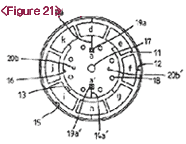
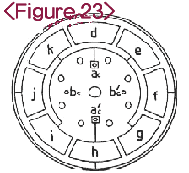
And small conducting holes(19a, 19a', 20b, 20b') are drilled in all integrated electrodes(a, a', b, b'), so it is easy to connect them with conducting wires. And when these rotors are put in solvent with chloride of second iron, copper is left in place with tape and enamel posted but the other copper are dissolved and the rotors like Figure 17 and 18 are made. And in order to prevent short-circuit, the surface of a rotor is thinly painted with clear rocker.
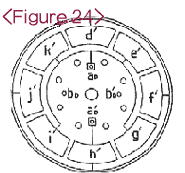
After making many rotors in this way and dividing them into two, One is marked with C and the other with D. And then integrated electrodes of Group C are marked with ac, b'c, a'c, b
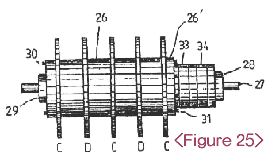
After that, put small circular plates(26) to adjust space between C and D like Figure 21, and pass the axises of rotor(27) and long bolts(30) through axis holes(17) and many bolt holes(18) in order of C, D, ..... And at the same time after passing conducting wire through conducting holes(19a, 19a', 20b, 20b') of the same integrated electrodes(ac-ac, a'c-a'c ..... b'D-b'D), solder integrated electrode and conducting wire.
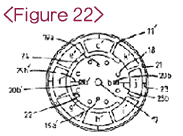
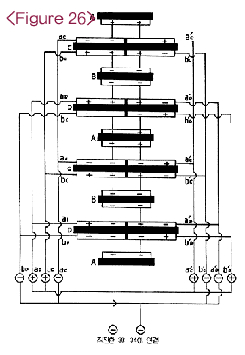
In that case, the number of integrated electrodes, or conducting wires is eight(ac, b'c, a'c, bc, aD, b'D, a'D, bD) but they should be divided into two. As it is shown in the development figure of stator and rotor in Figure 22, bD, ac, b'c and a'D are (-) poles and aD, bc, b'D and a'c are (+) poles(It is A.C but is classified into (+) and (-) like D.C because it is changed into the same pole.).
So when they are made into one, it leads to two. And finally after drawing these two conducting wires out of the last small circular plates(26') and connecting them with two slip rings(33, 34), make the insulated lines(11, 11') of rotor in a row and fasten both sides of the axises of rotor(27) and long bolts(30) with nuts(28, 29, 31). Now, the assembling of a rotor like Figure 21 is completed.
