
After assembling a rotor and a stator in this way, when both of them are combined, it becomes an electrostatic induction generator. Now, after assembling a stator, the way to combine it with a rotor will be described. First, divide stators made like Figure 16 into two(A and B) and mark the bottom stator of A as A1, the top stator of A as A2, the bottom stator of B as B1, and the top stator of B as B2. And, as illustrated in Figure 23, fasten front and back supporters(39, 39') on prop(38) with acryl sticks(41, 41') 3[mm] thick and then fasten stators with adhesive in order of A1, B1, A1,.... on acryl sticks.
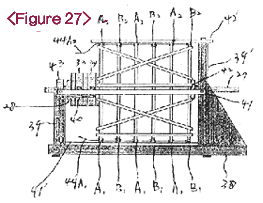
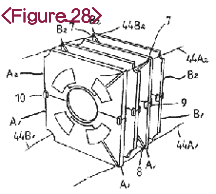
the assembled stator and fasten the bearing And then put the rotor on (43) of the axis of the rotor on supporters(39, 39') with nuts to make the rotor rotate well. And fasten acryl stick(42') standing on both sides with adhesive, pushing A2 into the grooves(9,10) of A1 and B2 into B1.
And fasten the stator with acryl sticks diagonally so as to be crushed(Treat back side with the same way as front side). And as illustrated in Figure 24, pass conducting wire(44A1) through the coupling hole(8) of A1, conducting wire(44A2) through the coupling hole(7) of A2, conducting wire(44B1) through the coupling hole(8) of B1 and conducting wire(44B2) through the coupling hole(7) of B2, and connect 44A1 with 44A2 and 44B1 with 44B2. If so, all stators are connected with two conducting wires.
When generating electricity, connect these two conducting wires with (+) and (-) poles of D.C. high voltage generating device.(A simple-system stator is one that connects all of the stators with one conducting wire and then connects the conducting wire with either of (+) and (-) poles of D.C. high voltage generating device.). And finally after contacting brush(40) with slip rings(33, 34), fasten it with supporter(39). Now, an electrostatic induction generator like Figure 23 is completed.
As mentioned above, I explained the making of an electrostatic induction generator. But this is not practical but is made for the purpose of experimenting. So in order to put it into practice, the selection of materials and the method of making need doing differently.
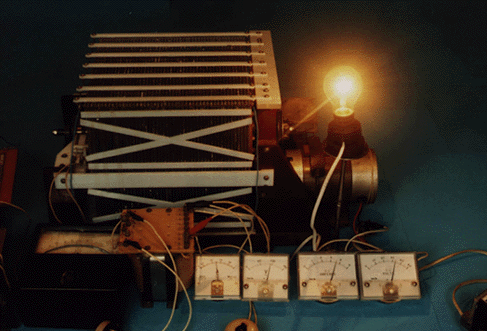 |
This is a picture shot to experiment in lighting an incandescent electric lamp with a generator of a simple-system stator of my own making. This experiment only is to prove the basic principle. When occasions come, I will do further experiment.
This is the explanation of the experimental processes of Perpetual Mobile (Electrostatic Induction Generator) and their result. I myself made a generator on these conditions for the purpose of experimenting the Electostatic Induction Generator.
① r2 - - - - - - 12.6[cm]
② r1 - - - - - - 8.4[cm]
③ d - - - - - - 0.094[cm]
④ n - - - - - - 47장
⑤ 2E - - - - - - 48극
⑥ a - - - - - - 0.1[cm]
When the capacity for it is calculated,
C = 1.13 × 10⁻⁸[F]
comes out (See the calculation formula of electrostatic capacity in the Electrostatic Induction Generator.)
When the weather is dry(Humidity: 50% below), raise ome A.C. generator to about 20,000[V] and rectified voltage to the stator for 0.3 to 0.5 seconds and then detach the diode from the stator.
In that case, the voltage falls sharply ; nonetheless, a relative high voltage remains in the stator for quite a long time. The experiments are at the level of a degee to prove the pinciple of the Perpetual Mobile because I couldn't generate a very high voltage.
| Input | Output | Remarks | ||
| Voltage | 28.7[V] | Voltage | First Electric Current 76[mA] | |
| Electric Current | 1.91[A] | Electric urrent | The Number of Rotation 25/sec | |
| Electric Power | 54.8[W] | Electric Power | ||
▒▒ TEST 2 ▒▒
| Input | Output | Remarks | ||
| Voltage | 25.6[V] | Voltage | 47.1[V] | First Electric Current54[mA] |
| Electric Current | 3.08[A] | Electric urrent | 0.56[A] | The Number of Rotation 20.6/sec |
| Electric Power | 78.8[W] | Electric Power | 26.6[W] | |
▒▒ TEST 3 ▒▒
| Input | Output | Remarks | ||
| Voltage | 25[V] | Voltage | 78.5[V] | First Electric Current41[mA] |
| Electric Current | 3.4[A] | Electric urrent | 0.43[A] | The Number of Rotation 19/secc |
| Electric Power | 85[W] | Electric Power | 33.7[W] | |
Test 1 shows the result that high voltage is added to
a stator. And the input is got by measuring the electric current and voltage
of D.C. motor.
Test 2 shows the result that the electric current and voltage of the second
side was measured after supplying the first side of a strong transformer
with the output(electric power) of generator. Owing to impedance(resistance)
of transformer, while the first electric current and rotation no. was
more decreased than Test 1, the input was increased.
Test 3 is the result shown when an incandescence electric lamp is
just turned on(Refer to photo.).
Because of the resistance of transformer and the incandescence electric
lamp, the first electric current was more decreased than Test 1 and 2
and the second electric current(0.43[A]) was also more decreased than
the second electric current(0.56[A]) of Test 2, while the input was more
increased than Test 1 and 2.
Thus, Judging from Test 1, 2 and 3, it is found that when electric current
increases, the input decreases and when electric current decreases, the
input increases. It means that input changes in accordance with the increase
and decrease of electric current and it is right opposite to the case
of electromagnetic induction generator.
The cause is that when electric current is increased, electricity as little
as the increase of electric current is left in rotor and thus horizontal
component to cause input becomes weak, on the contrary, when electric
current is decreased, electricity as much as the decrease of electric
current is left in rotor and thus the electricity produces a strong horizontal
component(Fx of Figure 2).
Accordingly, in order to more output than input, the amount of electricity
left in rotor should be diminished to the minimum by increasing electric
current to the maximum in case of strong resistance. So a plural-system
stator is needed to solve the problem. According to the experiment result
above, it seems that the principle of the Perpetual Mobile has proved.
The reason the output was small is that it was generated by the remaiing
voltage. In other words, I couldn't generate enough voltage to make a
large amount of output. If one wants to get more than tens of theousands
of volt of voltage one will practically have to give the stator a high
voltage continuously with D.C. high voltage generating device. Thus, let's
suppose that the output is calculated on the assumption that the stator
is given the voltage of 104, 2 × 10⁴[V] and 3 ×
104. And suppose that the capacity is C = 10-8[F]
to make the calculation simple although the original capacity is C = 1.13
× 10-8[F]. And then, put the voltage of 104[V],
2 × 10⁴[V] and 3 × 10⁴[V] on
① C = 10-8 [F]
② N = 5 × 10/sec (at a vacuum sate)
③ E = 102 pole ( I got 24 pole because I did't make a precise device. I thinks that more than 102 can be acquired if a previse device is made.),
ad one gets the output of
104 [V] , 2 × 10⁴[V] , 3 × 10⁴[V]
through the output formula of
P = 2CV 2NE[W]
P = 10[KW] , 40[KW] , 90[KW]
And also, when voltage can be raised even to hundreds of thousands of voit, one can guess how much the output of the Electostatic Induction Generator will be and how much a deree the voltage in output will take.
Like this, one can get a very high output by raising voltage. In that case, in order to raise voltage, electric power in principle isn't expended. In fact, a small amount of electric power leaks out.
But such electric power loss can be ignored because a high output is produced. When one generates electricity with this high voltage, one may doubt that it is dangerous. But there is no worry about it. After voltage is raised to generate electricity, the raised voltage can be lowered by transformer.
