
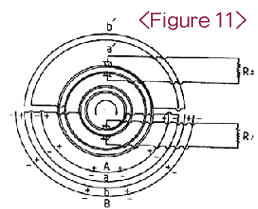
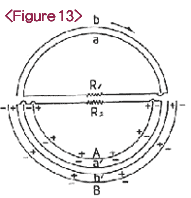
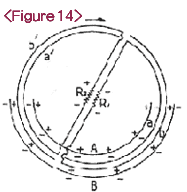
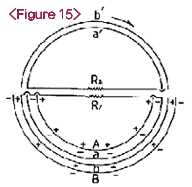
For the sake of convenience, after it was assumed that A and B in Figure 3 do horizontal movements, the principle was explained. But, in fact, because they do rotation movements, A and B are treated as stators, and a' and b' as rotors like Figure 7~11.
And though slip rings are shown to be four different-sized concentric circles, R1 is expressed to seem connected directly with a, b and R2 connected directly with a', b' by omitting slip rings and brushes in Figure 8~11.
And in case A and B are equal to a and b like Figure 7, the capacity is expressed as Cab, and in case A and B are equal to a' and b' like Figure 9, the capacity is expressed as Ca'b'. When (+) and (-) electricity are stored in A and B with D.C. high voltage generator, (-) and (+) electricity are produced in a and b owing to the action of electrostatic induction. And because A and B are completely insulated, it is assumed that (+) and (-) electricity once stored here are not changed and are preserved forever.
By means of the formula,
W = 1/2 CV2 [J]
electric energy of
is stored in Figure 7. In that
case, in order to make the voltage of electric energy V(Wab = 1/2 CabV2
[J]but the original voltage is V.), the voltage of D.C. high voltage generator
which is authorized by A and B must be made to be 2V because Figure 3
is the same that two in Figure 1 are connected in series(Refer to series
connection method of condenser) .
Like in Figure 8,
when a rotor is rotated to the direction of → , (-) electricity is produced
in a escaping from (+) electric attraction of A and (+) electricity is
produced in b escaping from (-) electric attraction of B.
But these electricities flow into R1 by their own attraction
as soon as they escape from (+) and (-) electric attraction of A and B.
And because the part which took (+) electric attraction of A appears in
a', electrostatic induction action takes place, and then (-) and (+) electricity
are produced. And because the part which took (-) electric attraction
of B appears in b', electrostatic induction operation occurs, and then
(+) and (-) electricity are produced. In that case, (-) electric attraction
of a' and (+) electric attraction of b' remain kept because they are attracted
by (+) and (-) electric attraction of A and B, while (+) electric attraction
of a' and (-) electric attraction of b' flow into R2 by their own attractions.
Accordingly, like in Figure 9,
the electric energy of
When a rotor reaches the state like in Figure 11, the electric energy
of
Wa'b' = 1/2 Ca'b'V2 [J]
in Figure 9 stored and the electric energy of
Wab = 1/2 CabV2 [J]
not taken by the electric attraction of A and B among electric energy produced newly by electrostatic induction action flow into R1 and R2, but the electric energy of
Wab = 1/2 CabV2 [J]
not taken by the electric attraction of A and B is stored. Therefore, the amount of electric energy which flows to R1 and R2 while a rotor is once rotated is
2(Wab + Wa'b') = 2(1/2 CabV2 +1/2 Ca'b'V2 ) [J]
이다. 그런데 설명의 편의를 위하여 용량을 Cab와 Ca'b'라고 구분해서 설명했지만 실제로는 같은 용량이므로 Cab 와 Ca'b'를 C라고 하면,
= 2(1/2 CV2 +1/2 CV2 )
= 2CV2 [J]
And for the sake of convenience, Cab and Ca'b' are distinguished, but because they are actually the same capacity, if Cab and Ca'b' are C,
W = 2 CV2 Nt [J]
And because the amount of electric energy flowing into R1 and R2 is proportioned to the number of rotations, if the number of rotations per t second is N, the following expression becomes made.
Like this, whenever a rotor is half rotated, a half of the electric energy newly produced by the stored electric energy and electrostatic induction action flows into external circuit, and the other half is repeatedly stored and at the same time electricity comes to flow, the direction of electric current changing. In that case, the type of wave motion gets rectangular. In other words, electric current is proportioned to the area of rotor, whenever a rotor is half rotated, the direction of electric current is changed. And also, because the area of rotor is linearly constant whenever changed again, it gets developed into a rectangle-wave alternating current.
But this is not a good form of wave. In order to get an applicable big output, the voltage should be strengthened to generate electricity. But it cannot be used as it is.
So the voltage should be moderately lowered by using a transformer, in that case sine wave is the most efficient. Electric current is proportioned to the changing area of rotor.
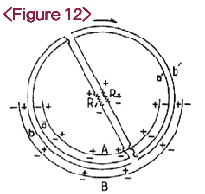
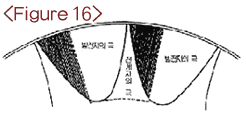
Like in Figure 12, either the pole of electric connector may be made rectangular(dotted line) and the pole of rotor may be made a form of sine, or the polar number may be heightened to the maximum because the higher the polar number gets, the closer it gets to sine wave. Accordingly, because the polar number is heightened to the maximum to make output high, the pole of rotor necessarily need not be made to be a form of sine.
