
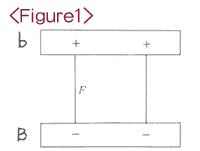
Like Figure 1, a condenser is made by making polar plate (b) and polar plate (B) close. In this case store (+) and (-) electricity in b and B respectively and electric attraction between b and B will occur. Replace the electric attraction with two straight lines and name one of them F. And suppose the (-) electricity stored in B is preserved forever as B is completely insulated.
Like Figure
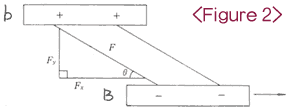
2, after b is fixed, push or pull B in the horizontal direction of
→, and be means of the vertical resolution of power, it is possible to
think of dividing F into horizontal component (Fx) and vertical component
(Fy). In this case, if B is pushed or pulled in the horizontal direction
of →, the electric force of Fx alone will resist it and Fy won`t in the
least. Thus, in order to move B in the horizontal direction of → without
it being added to, Fx must be made to become the same direction as Fy.
In order words, all of the electric force must be worked only to the direction
of 90°against the horizontal movement of B.
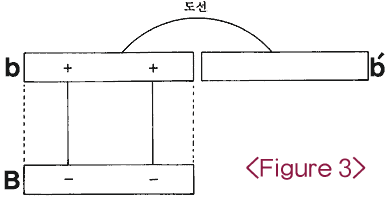
Like Figure 3, make another polar plate (b') close to b, and connect b with b' with a leading wire, and then push or pull B in the horizontal direction of →. Then, which way does the electric force take? In this case, suppose the resistance of the leading wire is null and the (-) electric force of B affects bb' as much as the length of B like the dotted line marked in the Figure.
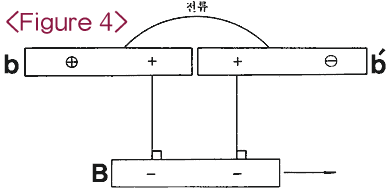
Like Figure 4, when B is pushed or pulled in the horizontal direction of →, b will have (+) electricity escaping from the (-) electric attraction of B and b' will have something under the (-) electric attraction of B and then (+) and (-) electricity will be produced in b' because of the operation of electrostatic induction. In this case, (+) electricity remains in b' because it is attracted by the (-) electricity of B, while the (-) electricity is moved by the attraction of the (+) electricity of B simultaneously with by the counter-attraction of the (-) electricity of B. It means that electricity flows in the leading wire. This phenomenon goes on while B makes horizontal movement.
In that case, the direction
of F taking place between B and bb' is very important. Because it becomes
a determining factor as to whether or not energy is provided according
to the direction of B. It means that the problem of energy supply has
to do with only the direction of F, with nothing else. Thus, it is necessary
to make the direction of F clear. As seen in Figure 4, when B moves into
the horizontal direction of →, the (-) electricity of B cannot have the
relation of attraction with the outside part of the dotted line of b in
which (+) electricity isn`t left and it cannot have the relation of counter-attraction
with the outside part of the dotted line of b' in which (-) electricity
isn`t left. Thus, as the direction of F(the line of electric force) against
the horizontal movement of B is 90°, nor the direction of b nor that of
b', it results in this expression.
Fx = Fcos 90˚ = 0
Fy = Fsin 90˚
= F (cos 90˚=0 , sin 90˚=1)
In that case, the direction of F taking place between B and bb' is very
important. Because it becomes a determining factor as to whether or not
energy is provided according to the direction of B. It means that the
problem of energy supply has to do with only the direction of F, with
nothing else. Thus, it is necessary to make the direction of F clear.
As seen in Figure 4, when B moves into the horizontal direction of →,
the (-) electricity of B cannot have the relation of attraction with the
outside part of the dotted line of b in which (+) electricity isn`t left
and it cannot have the relation of counter-attraction with the outside
part of the dotted line of b' in which (-) electricity isn`t left. Thus,
as the direction of F(the line of electric force) against the horizontal
movement of B is 90°, nor the direction of b nor that of b', it results
in this expression.
I, the inventor of the Electrostatic Induction
Generator, made a experimental generator by using such a principle and
obtained a patent(patent no. 8606) on it on September 10, 1980. (Refer
to pp.121~127 on the copy of the patent certificate and its public information)
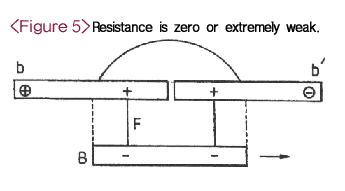
And after that, I have kept on studying and testing on it and one day I confirmed that the direction of F changes according to whether its electric resistance is strong or weak. In other words, when electricity flows well by making the electric resistance null or extremely weak, the direction of F becomes 90°as illustrated in Figure 5. On the other hand, when electricity becomes difficult to flow by making the electric resistance strong, it causes an amount of positive(+) electricity which has not become electric current to remain on (b), and then the attraction between the electricity and negative(-) electricity on (B) makes the direction of F go over 90°as illustrated in
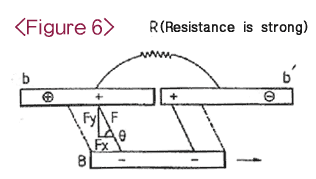
Figure 2. The result is that (Fx) playing a role as a cause of input gets strong. Accordingly, in order to get larger output than input and generate electricity simultaneously with providing some of output to input, or in order to generate electricity without energy being provided from outside, it is necessary to make the direction of F close to 90°even in case of a strong resistance. Now, the method of it will be explained.
